
Australia’s Timber Design Awards Target ‘the Missing Middle’
- 6 hours ago
- 4 min read
Organiser says the categories and the ways projects engage with the awards have broadened as new project types enter, with more and more entries judged before the 21 October gala.

Kylan Low, organiser of the Australian Timber Design Awards. (Photo Credit: Supplied)
Australia’s Timber Design Awards have outgrown exemplar projects, with more and more diverse examples of timber design than in past years. That is according to Kylan Low, the organiser of the 27th awards, who told Wood Central on Wednesday that entries are widening across every category ahead of a 21 October gala at Sydney’s Museum of Contemporary Art.
“Every year’s a wonderful year, but this year is truly an exceptional year,” Low said. The structural engineer, in his third year running the awards, describes the entry list across those years as “an ever-widening, broadening ink blot on the page”, with a wider variety of commercial, residential, and sports projects, and enough sports halls entered to warrant a new sports and recreation category.
Low wants every entry to tell “the story of where it was grown, who made it, why it was chosen, and of course what the timber does in the buildings for the people who use, work, live and play around their structures”, the supply chain story he described in April as beginning in the forest and running through sawmills, engineers, and builders.
Wood Central’s Jason Ross speaks to Kylan Low about the 2026 Australian Timber Design Awards, the judging bar, and the field of 57. Footage courtesy of Wood Central / Central PR Group.
“Preference is generally given to projects that are doing something that is genuinely new within Australia,” Low says of a bar the wider field has not lowered, and he calls International House “very, very new on the Australian stage” when it won, while both that building and James Fitzpatrick’s Seed House “would have a hard time winning” if they entered this year, “because it’s now 2026”. Design, the fibre, and the engineered product are judged together, “which is what makes the judging really difficult”, and he wants the 2026 field to “celebrate different solutions, new solutions, and really bold, appropriate, cost-effective, beautiful solutions”.
The Cutaway at Barangaroo sits in the public building category, and the Sydney Fish Market, which opened on 19 January under its 594 glulam beams, in commercial, and Low counts both among the projects that reach past the profession, “things that get lay people excited in a way that’s really exciting for the whole industry”.

The Cutaway’s 13 timber trees lit in blue at the venue’s free public opening weekend at Barangaroo Reserve. (Photo Credit: Kylan Low of the Timber Development Association, supplied to Wood Central / Central PR Group)
Sydney, Melbourne, and increasingly Brisbane remain the hotspots, but Low says this year has “a far broader reach”, with strong entries from Canberra, regional Victoria, and regional New South Wales, including a project at Gosford and the Hoskins Building in Wollongong. Adelaide sends the Adelaide Aquatic Centre, whose 52 beams and columns of up to 37 metres were milled in Austria and trucked in under police escort, along with the Tonsley Technical Centre and the Flinders Factory of the Future.
Canberra’s Thor’s Hammer has three projects in the field, one of them a furniture-and-joinery finalist, with concierge desks for the Anzac Park East precinct built from blackbutt and blue gum salvaged from 1960s Canberra homes. Recycled timber runs through the regional entries too: Low names Flooded Gums, which reassembled timber from across the state in the Hunter Valley, and Wilson’s Cottage near Kiama, built from timber that served a few decades in Sydney’s inner west, while the softwood frame and truss market “continues to make more high volume and really, really important buildings all across the country”.

Rubner glulam beams are installed over Blackwattle Bay during the construction of the Sydney Fish Market roof, with the Anzac Bridge beyond. (Photo Credit: Supplied to Wood Central / Central PR Group by Rubner Holzbau GmbH ‑ Srl)
A high-volume developer and “a second-year furniture maker” run the same race, Low says, in a field now filling the missing middle between the landmark and the everyday building, and the sculptural features of the large projects are “shown very strongly in the furniture and joinery projects too. It’s just a question of scale, which is what makes it interesting.”
Low says getting more timber into buildings “all flows from one word, which is just to de-risk”, through research, guidance, standards, and “demonstrating and celebrating the successes of teams that manage to execute really, really well and with low risk”. “Any risk perceived or real is not working for us,” he said.
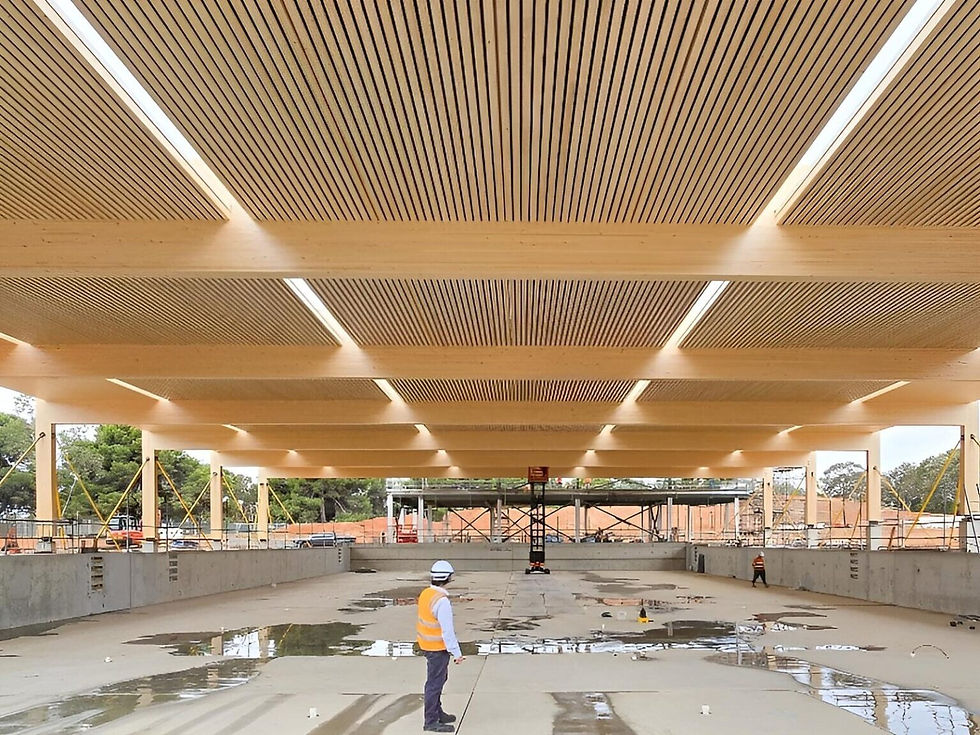
The Adelaide Aquatic Centre roof during installation. Tyson Infanti of Hasslacher Timber Australia told Wood Central in July 2025 that 324 cubic metres of glulam, 108 cubic metres of cross-laminated timber, and 3,130 square metres of prefabricated ceiling modules went into the roof. (Photo Credit: Hess Timber)
Asked whether the industry has to move from the exemplar to the expectation, Low called it “a great way of putting it”, and said the high-profile projects have reached the point where people outside the industry “might scratch their heads and think, what, this is unusual?”, with the aim now “to get to a point where it’s not so special anymore”.
The gala dinner is the perfect place to learn about timber design
The People’s Choice poll closed on Friday, with more than 2,000 votes cast, and its winner will be announced alongside the category winners at the gala, which Low expects to draw a full house to the museum’s harbourside room.
For a developer looking for a project team, “picking a team from the roster of entries is not a bad place to go”, he says, since many of the same teams enter year after year and “most people who know a lot about this space know each other”. He calls the gala “the room to be in” for a team that wants “to tap people on the shoulder and learn who’s doing what”, with everyone from foresters to interior designers, engineers, and architects in one place once a year, “and this time it’s in Sydney”.
Tickets for the 2026 Australian Timber Design Awards gala on Wednesday 21 October are available here, and the shortlist is on the awards’ Instagram page.


Comments