
Canada Buys 56% More American Hardwood as Furniture Duty Nears
Buyers have taken $68 million of American oak and walnut over the last three months, with the plywood, fibreboard, and particleboard among 98 product lines hit with new duties from 19 August.

American black walnut, one of the two species driving Canada's 56.3 per cent increase in American hardwood purchases, worked into a finished surface. Walnut carried the largest single product gain worldwide in the March to May quarter at $69.7 million. (Photo Credit: Petr Krejci via AHEC)
Shipments of American hardwood lumber into Canada have reached US$68 million in three months, 56.3 per cent more than a year earlier, with the furniture Canadian factories build from that timber facing 50 per cent American duties from 19 August. That is according to new trade data from the United States Census Bureau, which puts the whole March to May trade at $444.1 million.
Oak, excluding red oak and walnut, drove the increase, as did the joinery and cabinetmaking species that leave the factory as tables, dressers, and dining chairs rather than as sheet material. Red oak moved the other way, falling more than $2 million in the previous quarter.
Washington has drawn its line in an awkward place for those factories, with Section 232 already covering upholstered seating, kitchen cabinets, and vanities. Each Section 338 proclamation exempts what it covers, leaving case goods outside both and requiring the full 50 per cent.

American white oak, the species group behind Canada’s growth, was recorded by the Census as oak, excluding red oak, rather than as pure white oak. Furniture built from imported hardwood sits among 98 forest product lines, drawing 50 per cent duties from 19 August. (Photo Credit: American Hardwood Export Council)
The new duties reach trade that the earlier rounds had spared, cutting the share of Canadian exports that USMCA can still shield from 85.6 per cent to 82.3 per cent. Furniture takes the 50 per cent on top of the 10 per cent forced labour duty that reached the border on 24 July.
“Overall, for us, 98 tariff line items were added for forestry,” Derek Nighbor, Chief Executive of the Forest Products Association of Canada, said of a count he described as a direct assault on the sector and its workers.
Hardwood producers in the United States have run this argument against a different buyer, with 32 members of Congress telling Trade Representative Jamieson Greer on 30 June that China must spend its procurement pledge on sawn hardwood rather than raw logs. Their case was that foreign mills turn American fibre into goods that compete back into the home market, and Canada now runs the same circuit over a land border.
“American forests are supplying the raw material for foreign mills to displace American workers,” the signatories told Greer in a letter led by Senators Shelley Moore Capito and Jeanne Shaheen.
It comes as Canadian softwood faces its own barrier, at an effective 34.83 per cent, with Commerce moving to cut the combined duties to 24.83 per cent at the preliminary stage. A final call is due this month at the earliest.
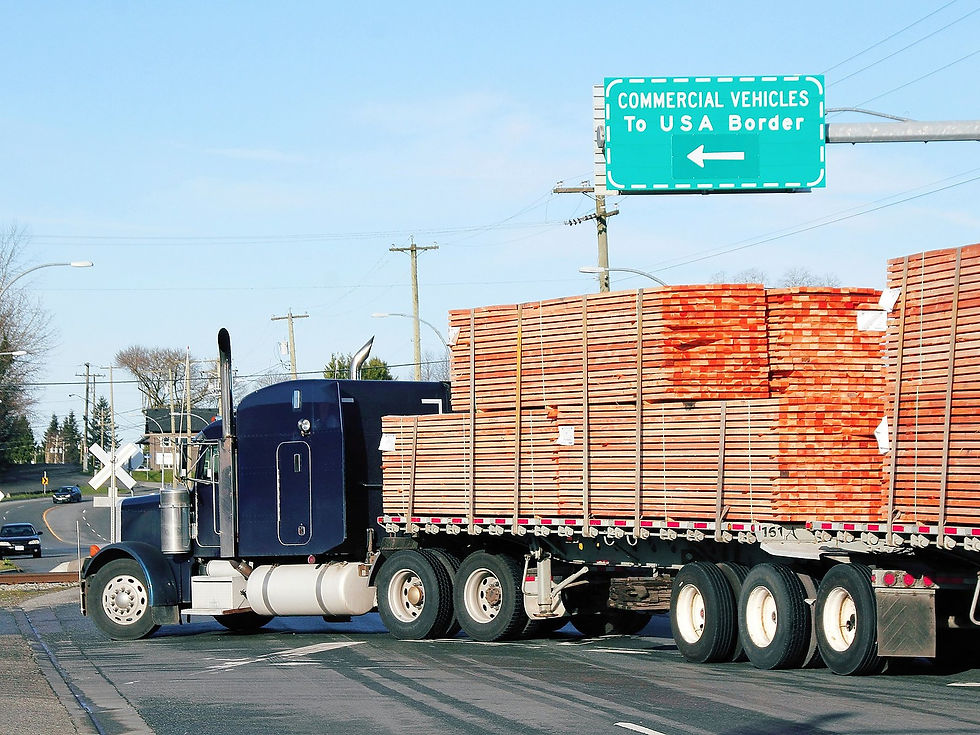
A flatbed of Canadian sawn softwood waits at a commercial approach to the United States border, a trade carrying an effective rate of 34.83 per cent and excluded from the Section 338 duties because it already falls under Section 232. (Photo Credit: Deposit Photos)
“If implemented, these sweeping 50 per cent tariffs represent a drastic and unjustified barrier,” Ian Dunn, President of the Ontario Forest Industries Association, said of orders reaching a province whose worst fire season on record has burned more than 7,250 square kilometres.
Canada has climbed to second place behind China on that buying, taking 15.3 per cent of every dollar American mills earn abroad, and no other major market grew faster over the year. China itself held the lead at $146.1 million and rose 14.4 per cent, while Vietnam added $10.8 million on the quarter behind walnut and yellow poplar.
American mills are selling more of their output into fewer markets, with the top three accounting for 62.1 per cent of export value, up from 55.7 per cent a year earlier, even as the number of active destinations grew from 87 to 93. Walnut supplied the largest single product gain, rising 20.9 per cent on a 30.5 per cent volume increase, which pushed its average price to $1,145 per cubic metre.


Comments