
Europe Must Cut Timber Harvest by 28% to Meet Its 2030 Target
Two studies backed by the European Space Agency have put the European Union 105 million tonnes short of its 2030 forest carbon target, with the Atlantic region needing to reduce harvest rates by 40 per cent.

Two log piles beside a forest track in the Czech Republic, where the brown crowns behind them show the natural disturbance losses that rose 45.5 per cent after 2018, alongside a 28.7 per cent rise in harvest losses. (Photo Credit: Artushfoto / Dreamstime.com)
Forests across Europe have shed above-ground biomass 46 per cent faster since 2018 than they did between 1985 and 2017, with the steepest rise in the dense temperate stands of Germany, Czechia, and Poland. That is according to Katja Kowalski, a postdoctoral researcher in Earth Observation for Ecosystem Management at the Technical University of Munich, whose satellite analysis published in Nature Geoscience on Wednesday puts gross biomass losses across the continent at 6.5 billion tonnes since 1985.
François Ritter and Philippe Ciais, climate scientists at France’s Laboratoire des Sciences du Climat et de l’Environnement, project the European Union’s forest carbon sink at 287 million tonnes of carbon dioxide equivalent by 2030, or 105 million tonnes short of the target their modelling sets at 392 million tonnes. Reaching that target takes a 28 per cent cut in harvest rates between 2025 and 2030 on their numbers, in a sink that stood at 467 million tonnes in 2010, over a period when the bloc’s forest area grew 1.69 per cent.’
Harvesting accounted for 82 per cent of the 6.5 billion tonnes lost across the 38 years, and natural disturbances for the remaining 18 per cent, with both categories rising after 2018 rather than one carrying the acceleration alone. Kowalski’s team found natural disturbance losses up 45.5 per cent after 2018 compared with the 1985 to 2017 baseline, and harvest losses up 28.7 per cent on the same measure, with the disturbance rise heaviest where the biomass was thickest.
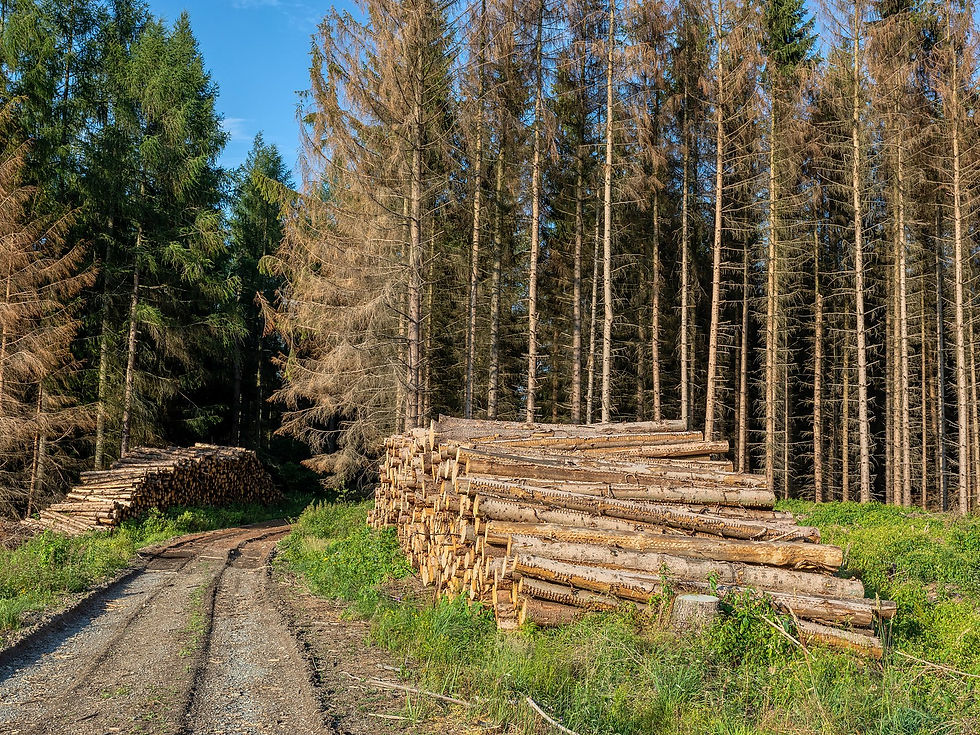
Two log piles beside a forest track in the Czech Republic, where the brown crowns behind them show the natural disturbance losses that rose 45.5 per cent after 2018, alongside a 28.7 per cent rise in harvest losses. (Photo Credit: Artushfoto / Dreamstime.com)
“The changes since 2018 are difficult to explain without climate change,” Kowalski said, with drought weakening trees across central Europe and European spruce bark beetles then killing mature trees within weeks.
Researchers had measured forest disturbance by area alone until now, which masked how much carbon those losses released, because a fire sweeping through the open Mediterranean woodland removes a fraction of the biomass held by the same area of dense temperate forest. Temperate forests gave up 86.9 tonnes per hectare disturbed compared with 26.8 tonnes in Mediterranean stands, with Germany, Czechia, Poland, and Slovakia reaching 117 tonnes per hectare, the highest absolute losses measured anywhere on the continent.

Absolute severity of above-ground biomass loss across Europe’s forests, measuring how much biomass disappears after wind, fire, insect damage, or harvesting. (Image Credit: ESA, data source Kowalski et al. 2026)
Atlantic Europe needs the steepest cut of the five regions modelled at 40 per cent, compared with 36 per cent in the Alpine region, 29 per cent across the Mediterranean, 28 per cent on the Continent, and 27 per cent through the boreal north. Boreal forests lose the largest share of what stands there when they are cut, at 67.1 per cent of pre-disturbance biomass density, with Kowalski’s team naming Finland, Sweden, Norway, and Estonia as the countries that harvest most intensively and have the lowest tree retention.

Required cut in harvest rates by biogeographical region to reach the 2030 forest carbon sink target, under business as usual and under a collapse scenario built on a 25 per cent rise in natural disturbances. (Wood Central chart from Ritter et al, National Science Review 2026)
“Europe can increase its forest area but still lose carbon sink capacity,” Ciais said, calling for forests to be managed differently and above all harvested less as natural disturbances keep rising.
“Most disturbed areas will eventually regain their role as carbon sinks,” Cornelius Senf, a forest ecologist at the Technical University of Munich and a co-author of both studies, said, arguing that managers now need to adapt forests to future conditions to rebuild that storage.
A continent-wide harvest reduction may increase carbon leakage outside Europe as buyers source the same volumes elsewhere, Ritter’s team concedes, naming thinning, changed rotations, and biodiversity-oriented regeneration as options its estimate leaves uncosted. European wood processors already face tightening pressure on where their fibre goes, with Brussels narrowing the bioenergy criteria under the revised Renewable Energy Directive and EU fuel rules steering forest residues toward costlier synthetic aviation pathways.
Finland’s environmental institute reached a similar conclusion in 2024, calculating that the country would need to cut emissions by at least 25 per cent to keep its sink in line with a 2035 carbon-neutrality commitment. The collapse scenario Ritter’s team modelled, built on a 25 per cent rise in natural disturbances and a 10 per cent fall in forest growth, would take the European requirement to 49 per cent.
Ritter’s team counts 38 million trees planted under a pledge of three billion, and reports that 60 per cent of Europe’s forests are on a declining path as carbon sinks between 2010 and 2021. Only Hungary and Liechtenstein have reported a significant national increase.
For more information: Kowalski, K., Viana-Soto, A., Brandt, M., Ciais, P., De Keersmaecker, W., Fensholt, R., Pugh, T. A. M., Xu, Y., & Senf, C. (2026). Accelerating biomass loss from forest disturbances across Europe. Nature Geoscience. https://doi.org/10.1038/s41561-026-02032-y · Ritter, F., Ciais, P., Senf, C., Santoro, M., Xu, Y., Pelissier-Tanon, A., Schwartz, M., Fayad, I., Carvalhais, N., Brandt, M., Fensholt, R., Besnard, S., & Avitabile, V. (2026). Alarming decline in the carbon sink of European forests driven by disturbances. National Science Review, nwag354. https://doi.org/10.1093/nsr/nwag354


Comments