
Europe Now Produces 8% Less Furniture Than Before the Pandemic
Updated: Jul 30
Real output has gone backwards since 2022, with three straight years of decline leaving factories producing less furniture than in 2018, even as the industry's headline value holds near record levels.

Stacked particleboard components fill the floor of a furniture plant, the panel-based production that dominates an industry Furnilytics says is making 8 per cent less than before the pandemic, despite a €123.9 billion headline value. (Photo Credit: Viorel Dudau / Dreamstime)
Factories across Europe are making less furniture than before the pandemic, with inflation-adjusted production falling to €98.6 billion in 2025, 8 per cent below its 2018 level, even as the industry’s headline value remains at €123.9 billion. That is according to new analysis from Furnilytics, the furniture market intelligence platform, which uses Eurostat data to track nominal and real manufacturing output across 28 European countries and finds a recovery driven by rising prices rather than rising volumes.
Measured by value alone, the rebound looks complete, with production climbing from €100.7 billion in 2020 to a record €130.3 billion in 2022 before settling at €123.9 billion in 2025, 15 per cent higher than in 2018. Adjusted for inflation, the figures reverse: real output peaked at €111 billion in 2022 and then declined for three consecutive years.
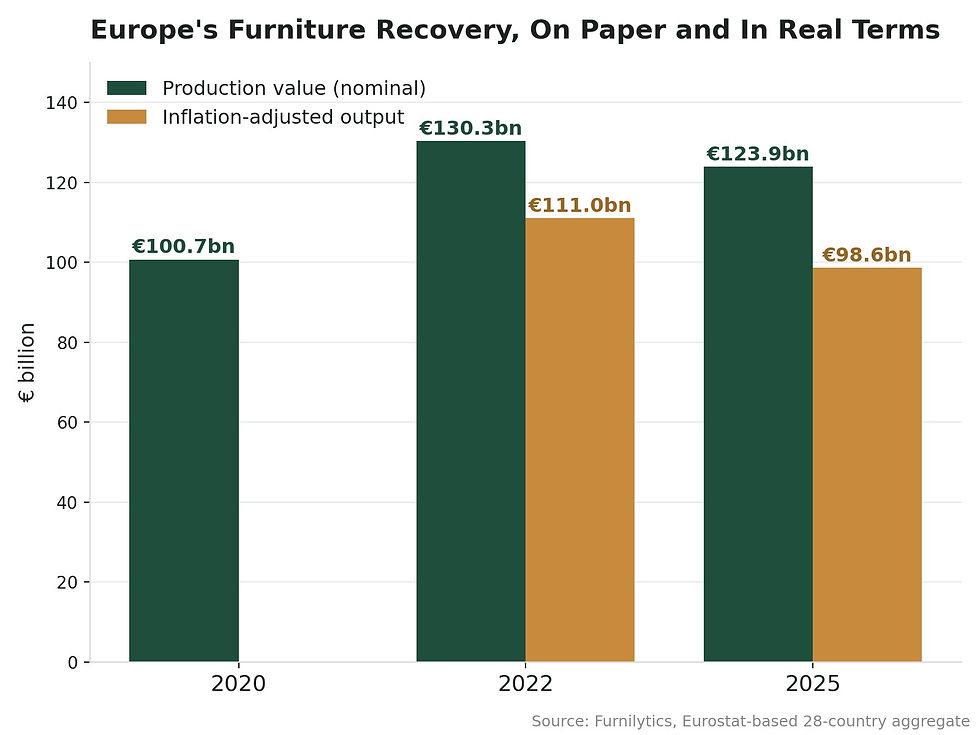
Europe’s furniture production value sits 15 per cent above 2018 on paper, but inflation-adjusted output has fallen for three consecutive years to €98.6 billion, 8 per cent below its pre-pandemic level. (Image Credit: Wood Central, data from Furnilytics)
Production stays concentrated in a handful of countries, with Italy leading the continent at €27.9 billion in 2025, followed by Germany at €20.7 billion and Poland at €13.1 billion. Between them, the three account for 49.8 per cent of Europe’s total, and the ten largest producers supply more than 80 per cent of the market.

Italy, Germany, and Poland account for 49.8 per cent of Europe’s furniture production, with the ten largest producers supplying more than 80 per cent of the market. (Image Credit: Wood Central, data from Furnilytics)
Germany carries the sharpest version of that strain, with industry associations reporting turnover fell 7.8 per cent in 2024 and a further 3.4 per cent to €15.789 billion in 2025. German makers have already urged Europe to build more houses and pressed Brussels to enforce a 2018 tariff pact shielding their exporters from Washington’s furniture levies.
“We believe the industry has passed the lowest point,” Jan Kurth, managing director of the German furniture industry associations, said in August 2024, a floor the market fell through in the year that followed. Kurth warned in May that renewed inflationary pressure, tied to energy prices from the conflict with Iran, is feeding fresh uncertainty among consumers.
Much of the sector’s nominal resilience has come from pricing, with producer prices surging 20.5 per cent between January 2021 and March 2023 as manufacturers passed on higher energy, raw material, and logistics costs, one of the sharpest inflationary runs the industry has recorded in decades. Prices stabilised through 2023, 2024, and 2025 without returning to pre-2022 levels, and they rose a further 1.3 per cent between December 2025 and April 2026, the strongest increase in more than two years.
It comes as fresh input costs build for 2026, with the analysis warning that geopolitical tensions in the Middle East keep energy markets uncertain and that tighter supplies of methanol and other chemical feedstocks are pressing on resin and panel production costs. That cost pressure extends well beyond the EU, with Russia’s panel makers petitioning the Kremlin for price relief after urea, the feedstock behind the resin that binds most particleboard, more than doubled between March and May.
Seven years on the factory floor sit behind the platform’s numbers, with founder Thijs Meijerink combining wood technology studies in Sweden and Germany with quality and development roles before moving into large-scale data science. “We share weekly analytics, so we open the industry to free data-driven insights,” Meijerink told Big Furniture Group, whose readers now receive his country-by-country breakdowns of production, trade, and pricing.


Comments