
Japan Moves to Replace Imported Wood to Pay Its Own Foresters
- 2 hours ago
- 2 min read
The Forestry Agency has set domestic wood use at 42 million cubic metres by 2035, with performance indicators attached to the five-yearly plan for the first time.
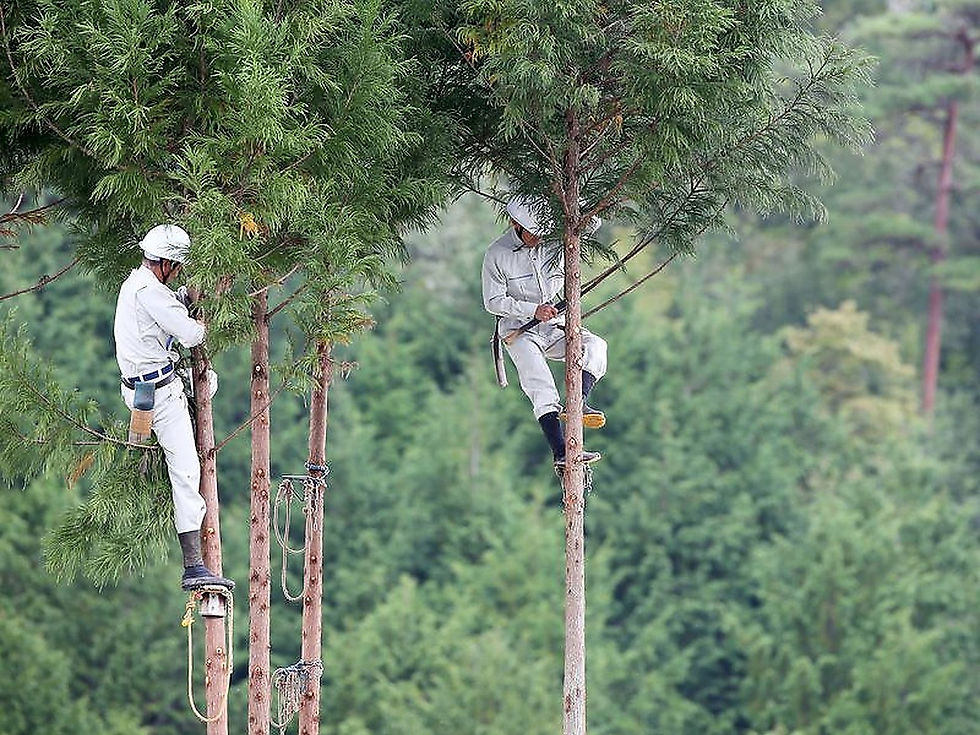
Foresters work aloft in a planted conifer stand, the tending Japan's new Basic Plan needs at scale if domestic wood use is to reach 42 million cubic metres by 2035. (Photo Credit: Japan Forest Agency)
Tokyo has committed to taking seven million more cubic metres of wood from Japanese forests by 2035, and the foresters who would cut it are walking away from holdings they cannot afford to thin. That is according to the Forestry Agency, whose Forest and Forestry Basic Plan received Cabinet approval on 5 June and raises domestic consumption from 35 million cubic metres to 42 million, taking self-sufficiency to 49 per cent.
Total demand climbs by three million cubic metres to 85 million across the same period, so only four million of the seven million displaces anything shipped in, according to Wood Central’s calculation from the plan’s demand table. Imports fall from 47 million cubic metres to 43 million, one cubic metre in every twelve Japan currently buys abroad.
“Stagnant timber prices, owing to replanting not being taken into account and to imported timber leading the market,” runs the challenge list in the plan’s own summary, which also names deteriorating management appetite among owners and insufficient replanting across ground it has zoned for commercial forestry.
Miyagi Prefecture foresters had reached the same conclusion five days before Cabinet met, chasing internationally certified carbon credits to finance thinning that timber returns no longer cover. “The value of forests has dropped so much,” Akio Abe said, and the Ishinomaki District Forestry Association’s associate director described owners abandoning their stands after decades of population decline and cheap imported timber.
Planted sugi and hinoki cover 10.2 million of Japan’s 25 million forested hectares, an inheritance the Agency’s resource survey counts as 60 per cent available for immediate harvesting and 80 per cent by 2032. Forestry employees averaged ¥3.61 million in 2022, compared with ¥ 4.58 million across all industries, and the plan makes closing that gap one of its inaugural performance indicators, alongside reducing the workplace injury rate from 23 per thousand workers to 16.
The Agency’s timber trade office counts import expenditure down 17 per cent between 2022 and 2024, with log volumes 29 per cent lower and glue-laminated timber 26 per cent lower. Softwood lumber imports fell to 3.86 million cubic metres, a third of the 1997 volume, with the United States Department of Agriculture reporting European Union mills accounting for 56.1 per cent of the remainder, against Canada’s 21.4 per cent.
Vietnam, the European Union, China, and the United States lead the trade office’s list of Japan’s main suppliers by import value, with Australia listed only for woodchips.
By 2030, the plan aims for 23 million cubic metres of domestic construction timber and two-thirds of the planted estate to be zoned for commercial production. Remote sensing and artificial intelligence would clarify boundaries and ownership that the Agency cannot currently establish, and a revised forest management law would raise consolidated holdings by 30 per cent to 2.1 million hectares.


Comments