
Nordic Sawmills Struggle to Match German and Austrian Spruce Prices
Central European producers have reclaimed the cost advantage inside fourteen weeks, with the assessment that called their salvage surplus spent in April now recording Nordic suppliers unable to compete on price.

Debarked sawlogs fill the yard at a European sawmill, the raw material whose cost has climbed while sawn timber prices moved sideways, leaving Nordic producers unable to match the offers now reaching their customers from Germany and Austria. (Photo Credit: Shutterstock Asset ID 48959254)
Mills in Germany and Austria are selling spruce at up to €20 a cubic metre below Nordic prices, with end users reporting daily approaches from Central European suppliers after their volumes. That is according to Tuomo Neuvonen and Cat Vitale, the commodity analysts responsible for a European sawn timber price assessment published on Monday.
The April edition had counted the Central European salvage surplus as spent only 14 weeks earlier, with German mills then sourcing from a depleted forest base as roundwood availability tightened, while Nordic producers held the cost advantage.
“Trying to steal volumes” is the phrase one market source used for the Central European sellers now soliciting end users every day, in an assessment that describes a continent flooded with spruce and purchasing behaviour shifting with it.
Redundancies have already followed in eastern Finland, with Binderholz Nordic putting its entire 250-strong workforce at Lieksa and Nurmes into statutory change negotiations that commenced on 17 July, and no more than ten permanent dismissals and 90-day temporary layoffs are proposed.
“The price of raw material is unsustainably expensive,” Joonas Vitri, Managing Director of Binderholz Nordic, told Lieksan Lehti, naming the end of Russian imports as the reason sawlog prices escalated and the Iran conflict as the reason energy costs climbed while demand fell.
Both mills belong to Binderholz, Europe’s largest sawmiller, with annual sawlog consumption across the two Finnish sites close to one million cubic metres and a combined capacity of 450,000 cubic metres when the group acquired them from Vapo Timber in 2016.
Neither the company nor the Finnish publications that reported the negotiations have published an outcome, with the two-week consultation period having closed at the end of July, Wood Central understands.
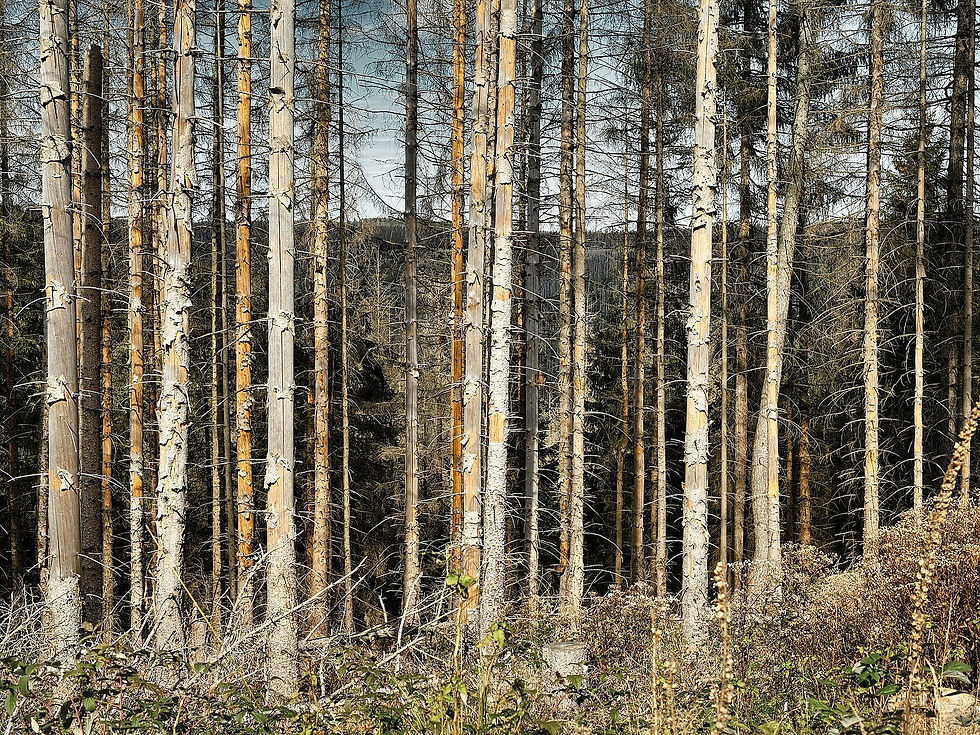
Bark-stripped spruce stands dead across a Central European hillside, the damage behind a salvage surplus counted as spent in April, when German mills were the constrained producers rather than the ones now undercutting on price. (Photo Credit: 44Photography via Dreamstime, ID 231151083)
Finnish roundwood costs have continued to escalate over the same period, with the Natural Resources Institute Finland putting pine sawlogs at 78.52 euros a cubic metre in June and spruce at 83.65 euros, up 7.3 and 8.4 per cent, respectively, from their January lows.
“Northern Europe is difficult. It’s a better situation in southern regions,” one market contact told the analysts of third-quarter demand, a geographical division already visible in the flows that left the UK, taking barely 1 per cent of EU log procurement, while central and eastern Europe took more.
Nordic majors have already documented the consequences in their own financial reporting, with Södra’s sawmills reporting 215 million kronor in the red for the second quarter, and SCA’s wood division recording an operating profit of 17 million, down 93 per cent as deliveries declined 12 per cent.
Only the UK recorded price movement of any consequence, with imported pine grades falling while domestic spruce held at May levels. The upper ends of the assessed ranges for Pine US 50x150mm and Pine V and VI dropped 5 euros a cubic metre, cutting midpoints by 0.8 to 1.1 per cent.
Some Swedish producers have continued offering low-priced material to sustain production volumes and liquidity, with their own reports conceding that certain sales sit below profitable levels and there is no consensus among market participants on what would end the practice.


Comments