
Russia’s Forestry Industry Faces Financial Ruin, New Siberian Study Warns
- Jun 30
- 3 min read
Updated: Jul 30
A drop from a US$311 million profit in 2021 to a $142 million loss by 2024 has left about half of all forestry firms unprofitable and dozens facing bankruptcy, as exports collapse across China, Japan and South Korea.
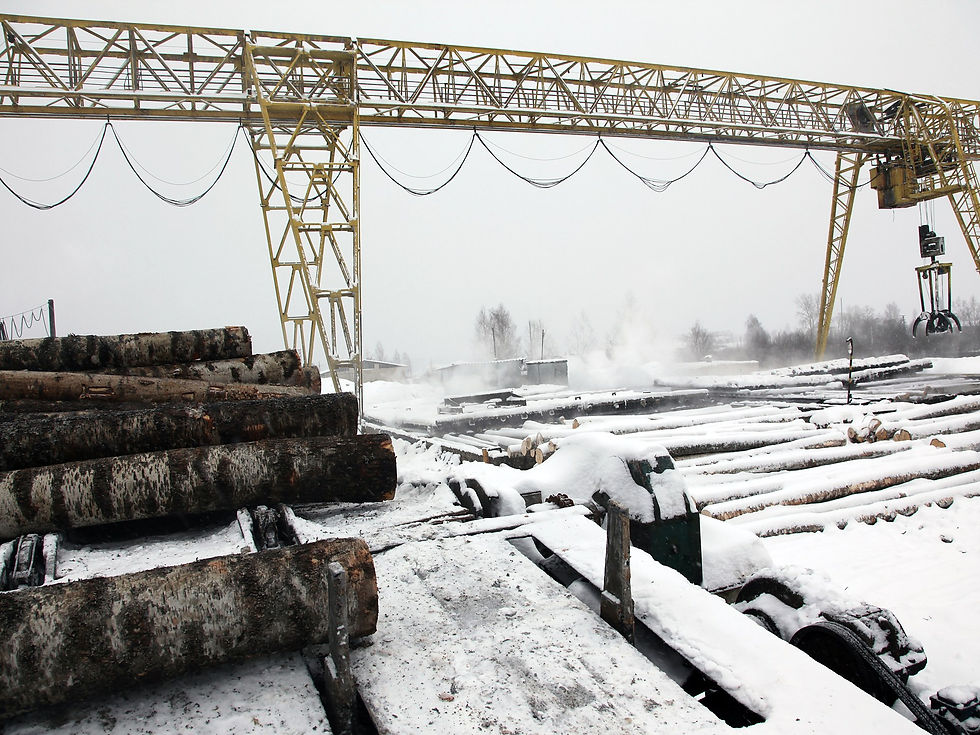
A snow-covered log yard sits idle beneath a gantry crane at a Russian timber mill, where a swing into loss and collapsing exports have left producers with stockpiles they cannot sell. (Photo Credit: ID 38783374 © Ben De Bruyn | Dreamstime.com)
Russia’s forestry sector fell from a combined net profit of 24.3 billion roubles ($311 million) in 2021 to a net loss of 11.1 billion roubles ($142 million) by 2024, with corporate debt rising 1.6-fold over the same three years. That is according to a study by the Institute of Economics and Industrial Engineering at the Siberian Branch of the Russian Academy of Sciences, which found that the industry is approaching a systemic crisis driven by sanctions, weak demand, and the cost of credit.
About half of all forestry companies were loss-making last year, the study found, with revenue falling, reserves depleted, and high interest rates effectively closing off access to new financing. Within that, smaller producers carry the heaviest exposure, holding the thinnest reserves and the least room to absorb costs that keep climbing as their order books shrink.
Consolidation offers no escape from the downturn, the researchers warned, with losses so widespread across the sector that stronger firms cannot absorb the failing ones. “Dozens of companies are set to go through bankruptcy,” the study said, judging any recovery to be more than a year away.
That financial damage tracks a collapse in the export markets Russia pivoted to after Europe shut its doors, with sawn-timber shipments to China falling 30 per cent year on year to 2.6 million cubic metres in the first four months of 2026. Export revenue from that trade dropped 26 per cent to $603.7 million over the same period, according to the Vedomosti business daily, citing data from Lesprom Network.
Yet the damage runs well beyond China, with shipments to Japan down 19 per cent and to South Korea down 18 per cent across the first four months, leaving Russian producers few outlets to absorb the surplus. Total sawn-timber exports fell 32 per cent to about 4 million cubic metres over the period, even though China still took roughly half of all Russian shipments in 2025.
Driving the China slump is a property downturn that shows little sign of easing, with home sales by value down 9.5 per cent in 2025 to their weakest level since 2009. Floor space sold shrank a further 11 per cent over the first five months of 2026, China’s National Bureau of Statistics reported, draining demand from the construction market that once anchored Russia’s mills.
The rupture with Europe dates back to 2022, when the EU banned Russian timber imports and forced producers to redirect almost all of what they cut to Asia. China absorbed 11.2 million cubic metres of Russian sawn timber in 2025, about half the country’s total exports, leaving the sector dangerously reliant on a single weakening market.
A strengthening rouble has deepened the squeeze by pricing Russian timber out of Asian markets just as demand weakens, stripping the cost advantage that carried mills through the first sanctions years. Meanwhile, Consultancy Strategy Partners expects exports to fall a further 7 to 10 per cent across 2026, with weaker construction, higher freight, and the currency all working against a rebound.


Comments