
Sixty Years of Data Show Prescribed Burning Cuts Wildfire Losses
- 10 hours ago
- 5 min read
Six decades of data show the west still burning five times more forest each year than Victoria, where wildfire kills 18 times as many people per million.
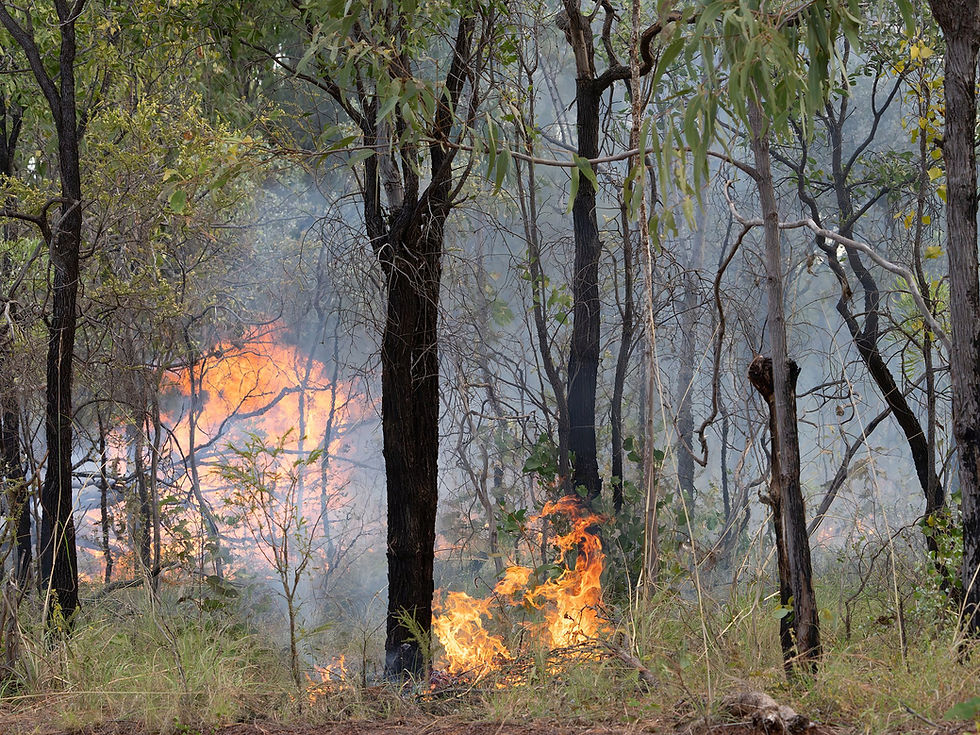
Low flame runs through the understorey during a hazard reduction burn in Australian woodland, with the canopy above it green and unscorched. (Photo Credit: Brian Scantlebury, Dreamstime)
Wildfire has consumed more than three times as much south-west Western Australian public native forest every year since 1995 as it did across the three preceding decades, while prescribed burning across those same forests has halved. That is according to John Cameron, a Traralgon forestry consultant whose 60-year meta-analysis with three former government scientists in Australian Forestry revealed that the state carries the heaviest fuel loads and the longest fire season of the three regions studied, and still loses the least forest.
Prescribed fire covered a mean 9.2 per cent of the south-west forest region every year between 1965 and 2024, compared with 1.9 per cent in Victoria and 0.7 per cent in New South Wales. At the same time, wildfire took the smallest share of the three regions in the west and the largest in New South Wales. Six decades of unplanned fire burnt 60 per cent of the west’s forest area, 112 per cent of Victoria’s, and 141 per cent of the estate in New South Wales.

Western Australia burnt 9.2 per cent of its forest region a year across the six decades and lost 1.0 per cent to wildfire, an order the other two regions reverse. (Graphic: Wood Central, data from Cameron et al. 2026, Australian Forestry)
Western Australia has the harsher fire environment on most measures, recording the lowest spring and summer rainfall, the highest drought index readings, and the most total fire ban days, though lower maximum wind speeds offset those conditions and Cameron and his co-authors conclude there is no significant regional bias in fire-proneness between the three.
Karri forest in the south-west also carries the heaviest fuel loads of the three.
Cameron found no measurable protection where a region burns less than 4 per cent of its forest each year, and significant benefit only above 8 per cent. Western Australia burnt 12 per cent of its forest region a year until 1994, and 6 per cent a year since.

Below 4 per cent of a region treated a year the study finds no measurable benefit at regional scale, and Victoria and New South Wales both sit inside that band. (Graphic: Wood Central, data from Cameron et al. 2026, Australian Forestry)
Victoria trimmed its own programme by more than a quarter between the first and second halves of the study period, and the share of the region lost annually to wildfire more than doubled, to close to 2.6 per cent. New South Wales lifted prescribed burning from a base Cameron describes as very low, and its wildfire area kept rising anyway.
New South Wales lost houses to wildfire at twice the Western Australian rate and Victoria at five times it, measured per million residents across the six decades.
Deaths ran five times higher in New South Wales than in the west, and in Victoria, where most of them occurred, Cameron found deaths rising in step with the number of houses burnt.
Dr Neil Burrows spent 42 years as an applied bushfire scientist, science manager, and fire policy adviser with Western Australia’s Department of Biodiversity, Conservation and Attractions and its predecessors, retired from the public service in 2019, and received the Australian Fire Service Medal the following year. Whilst David Packham worked two decades as a CSIRO bushfire scientist, and Dr Glen Kile ran CSIRO’s forestry and forest products division, before both asisted with the analysis.

Dr Mohammad-Reza Ghaffariyan, managing editor of Australian Forestry, the journal that published the study. (Photo Credit: UniSC Forest Research Institute)
“Relying on early detection and rapid initial attack/suppression has failed, and will continue to fail, particularly with multiple fire outbreaks in heavy, dry fuels,” the authors wrote adding that firefighters had attended more than 100,000 wildfires across the three regions over the six decades.
Fires starting in recently burnt forest either self-extinguish in very low fuels or are controlled quickly, Cameron says, and a prescribed fire burns below 500 kilowatts a metre where a wildfire can pass 100,000. Well executed, prescribed burning leaves tree crowns unscorched and much of the duff layer intact, consuming 70 to 90 per cent of each management cell and leaving riparian strips standing.
Burning programmes also build crews who know fire behaviour, forest conditions, and access routes, Cameron and his co-authors wrote, and they call a skilled firefighting force essential to suppressing wildfire safely.
Cameron and his co-authors disagree most sharply with Philip Gibbons of the Australian National University, whose team examined 13 wildfire events between 2009 and 2020 and, on the Australian Forestry paper’s reading, concluded there is no evidence that prescribed burning reduces house loss. Gibbons and his co-authors sampled 1,617 houses exposed to wildfire across southern Australia, and reported the share destroyed falling as the proportion of surrounding landscape previously burnt rose, once weather, terrain, and woody vegetation near the houses were controlled for, Wood Central understands.

A Department of Fire and Emergency Services notice marks ground scheduled for a hazard reduction burn in south-west Western Australia, on a trunk carrying the scar of an earlier fire. (Photo Credit: Garey Lennox, Alamy)
“Our findings, based on 60 years of data across three of Australia’s most fire prone forest regions, disagree with this conclusion,” they wrote, arguing that fuel reduction cannot stop at the edge of the built-up area.
Fuel management and a changing climate have driven the worsening fires of the past two decades together, Cameron argues, rather than warming alone before citing modelling that finds the mean time to climate stabilisation after net zero carbon dioxide emissions runs to 90 years.
Evidence Linking Bushfires to Logging Covers Just 2% of Australian ForestsIt comes after Forestry Australia, the journal’s published, pressed the same broad case in May, when a review it released found extreme fire weather and topography drive bushfire severity far more than harvesting does. Cameron and his co-authors cite a 2025 Commonwealth Forestry Association review which concluded that there was no evidence to support claims that forest disturbances, including prescribed burning raise landscape wildfire hazard. The authors also cite the University of California, Davis study in Science, which credited fuel treatments across the Western United States with returning US$3.73 in benefits for every dollar invested.
For Victoria and New South Wales, Cameron and his co-authors recommend incremental increases toward a first target of 5 per cent a year, the figure the 2009 Victorian Bushfires Royal Commission settled on in its 2010 final report. Victoria has averaged 1.6 per cent across the three decades to 2024.
For more information: Cameron, J. N., Packham, D. R., Kile, G. A., & Burrows, N. D. (2026). Contrasting regional prescribed burning regimes effects the extent and impact of forest wildfire. Australian Forestry. https://doi.org/10.1080/00049158.2026.2711913


Comments