
Australian Mills Consider Dumping Case on Russian LVL Glued in China
- 28 thg 8
- 4 phút đọc
Imports have jumped 63 per cent in a year, with Australia's peak forest products body arguing the Russian tariff stopped the wood but not the product.

Peeled veneer dries in racks at a wood processing plant in Neijiang, Sichuan, on 28 October 2023, the layers Chinese mills glue into laminated veneer lumber, and the step at which Russian wood becomes a product of China at the Australian border. (Photo Credit: Cynthia Lee / Alamy Stock Photo)
The Australian Forest Products Association is working with the Anti-Dumping Commission on an application regarding Russian wood entering Australia as laminated veneer lumber glued in China, a trade it estimates at up to 100,000 cubic metres a year. That is according to Richard Hyett, the peak body’s acting chief executive, who told ABC’s NSW Country Hour that the fibre is enough for more than 15,000 homes.
“We’re certainly working with the Anti-Dumping Commission on progressing an application, and it’s looking like there is a positive outcome in that space,” Hyett said, before adding that the process could take 12 to 18 months.
Hyett says Source Certain, a forensic laboratory that uses state-of-the-art technology to test samples, has tested the product and that larch, a species he claims China does not grow, is reaching Australia within Chinese LVL. Half the imported products it sampled for the Department of Agriculture, Fisheries and Forestry were not the origin, species, or genus their paperwork declared, in findings released under freedom of information earlier this year.

Charlie Watkinson, Source Certain’s General Manager of Technology and Commercialisation, examines an engineered wood sample under a digital microscope. The laboratory says it is building verification methods for layered products including LVL and plywood. (Photo Credit: Source Certain)
Declared LVL imports are up 63 per cent in a year on Australian Bureau of Statistics returns curated by the consultancy IndustryEdge, and mainland China supplied more than 69 per cent of the 205,343 cubic metres declared in the ten months to October 2025. Chinese shipments reached the wharf at A$276 a cubic metre compared with $733 for imported sawn softwood.
Canberra imposed an additional 35 per cent duty on all Russian and Belarusian imports on 25 April 2022, and the Australian Border Force notice extending it is in effect until 24 October 2027, Wood Central understands. Declared imports from Russia shut down overnight, Hyett says, and shipments from neighbouring countries using Russian fibre rose just as fast, an argument he first put to senators on 25 June.
Chinese mills responded to tighter European rules by gluing a thin layer of softwood to the outside of the product so it would be reclassified, Hyett said at that hearing, and Brussels opened a fresh anti-dumping action. Mills move fast, he says, and the frameworks built to catch them do not.

Richard Hyett holds a roll of certified toilet paper at the Senate’s Foreign Affairs, Defence and Trade References Committee on 25 June, where he told senators that declared imports from Russia shut down the day the tariff began and shipments from neighbouring countries using Russian fibre rose just as fast. (Photo Credit: Parliament of Australia)
Russian logs and veneer glued into LVL in China clear the substantial transformation test and ship without the duty, a step Hyett told senators is legal. His association asked them for the tariff on every product containing Russian material, anti-dumping action modelled on the European Union, border testing, and country-of-origin labelling.
“Large-scale dumping of engineered wood products on the Australian market,” Forestry Australia wrote in a submission the committee quotes directly. The Engineered Wood Products Association of Australasia told the same inquiry that no ban applies to Russian timber here, that the tariff is the only measure that does, and that both major certification schemes already bar Russian material.
Raff Ciccone, deputy chair of the Senate’s Foreign Affairs, Defence and Trade References Committee, signed the additional comments encouraging an application in the committee’s report on Russian sanctions, tabled on 20 August, alongside Dorinda Cox and Ellie Whiteaker. Australia signed up to the World Trade Organization, the Labor senator said, and has the right to use its anti-dumping processes.
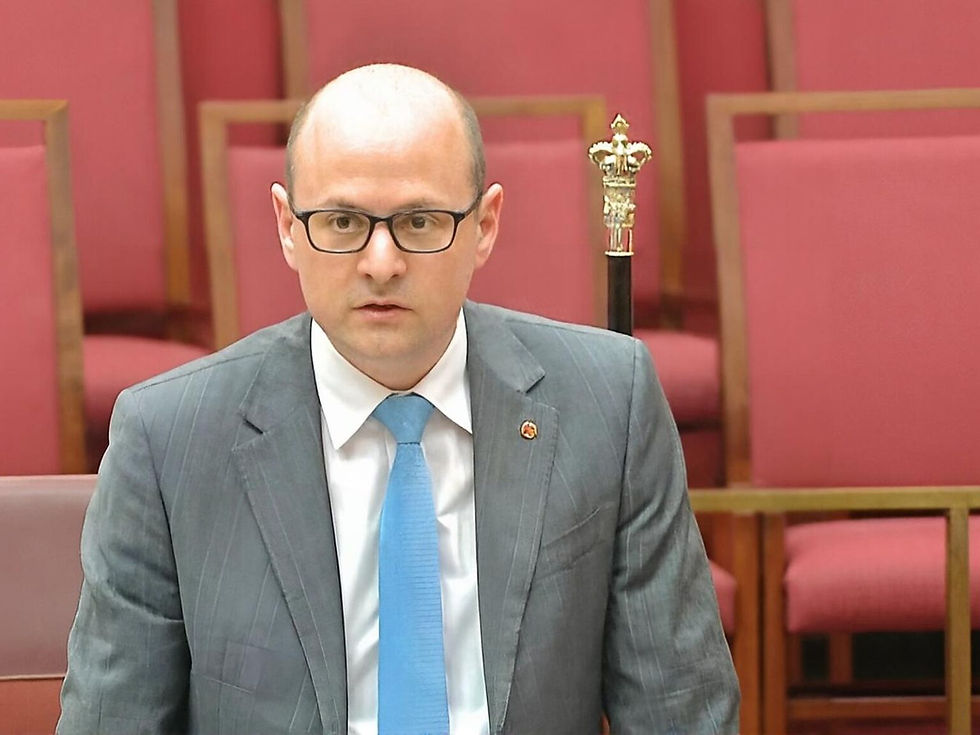
Raff Ciccone speaks in the Senate chamber in a file image; the deputy chair told ABC’s NSW Country Hour on Thursday that Australia signed up to the World Trade Organization and has the right to use its anti-dumping processes. (Photo Credit: Parliament of Australia)
“Ultimately we’ve got to use the mechanisms that are at our disposal,” Ciccone said, citing evidence to the committee that an A$6 billion timber manufacturing industry supporting 80,000 direct and 100,000 indirect jobs stands to lose. Victoria’s Green Triangle and the Snowy region of New South Wales are among the communities he names as losing work to Russian-origin product.
Senators named timber beside blended oils in the sixth of the report’s eleven recommendations to the Albanese Government, and found that one processing stop outside Russia makes the wood legally non-Russian at the border. No Australian instrument covers conflict timber as a category. The Commission opens an investigation only when Australian producers apply, and its last structural timber case excluded LVL from scope. Hyett estimates up to 6 per cent of the equivalent local market carries Russian fibre.


Bình luận