
Forestry Hubs Hear Risky Imports Now Double Australia’s Native Timber Use
Đã cập nhật: 30 thg 7
Exclusive: Alison Rudman, the Timber, Furnishing and Textiles Union's NSW Secretary, warns Australia is trading its mill jobs for blood timber, after the Commonwealth's entire 11-hub network gathered at Newcastle's Fort Scratchley to hear fresh research on the nation's reliance on wood from the world's most contested forests.
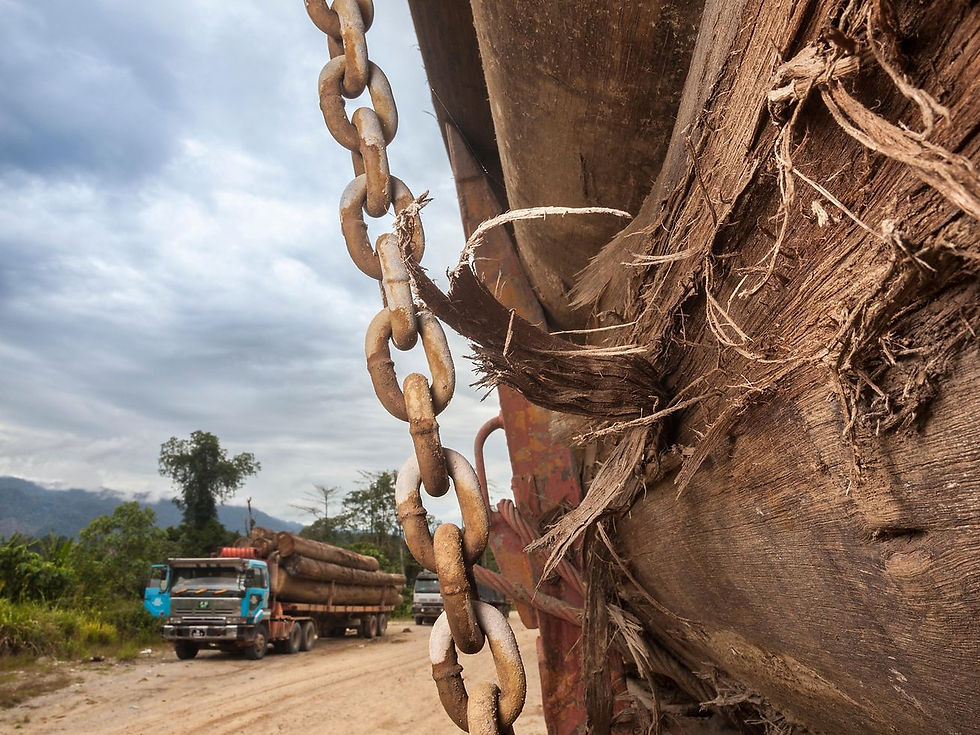
Every mill closure at home pushes timber demand into forests with far weaker protections abroad, Australia's 11 Regional Forestry Hubs heard in Newcastle. (Photo Credit: Alex Hyde in Borneo, Nature Picture Library via Alamy Stock Images)
Australia now consumes twice as much timber at risk of conflict and deforestation as it does wood from its own native forests, with every domestic mill closure pushing more of that demand into forests with far weaker protections. That is according to Tyron Venn, the University of Queensland forest economist who opened a national roundtable of hub managers on Tuesday with a new analysis of Australia’s solid wood production and imports.
“Surely we all want better than being forced to use blood timber,” Alison Rudman, the NSW Secretary of the Timber, Furnishing and Textiles Union, who spoke to Wood Central exclusively in the wake of this week’s forum. Rudman said Venn’s data confirmed “what common sense has long suggested” – that shutting down local timber jobs “doesn’t shut down demand for timber.”
“It just means it’s being imported from countries without Australia’s worker and environmental protections,” she said, one week after Pentarch Forestry shed a further 25 jobs at its Herons Creek mill. Rudman, however, welcomed the presence of “timber workers who are on the floor producing timber every day” among the sawmillers, processors and certifiers at Fort Scratchley.

The University of Queensland’s Tyron Venn presents data showing Australia consumes twice as much elevated-risk timber as wood from its native forests. (Photo Credit: Supplied to Wood Central / Central PR Group for exclusive use by the North East NSW Forestry Hub)
Held across two days, the forum drew hub managers from Tasmania to the Northern Territory, joined by researchers, processors, unionists and the Department of Agriculture, Fisheries and Forestry, which funds the 11-hub network. Wood Central understands a closed afternoon session included updates from every hub alongside briefings from DAFF’s Andrew Wilson and Australian Forest and Wood Innovations’ Patrick Mitchell.

Hub chair Andrew Hurford with StollzNow Research’s Giselle Stollznow at the national round table. (Photo Credit: Supplied to Wood Central / Central PR Group for exclusive use by the North East NSW Forestry Hub)
“It’s a great concept – it’s sponsored by the Commonwealth government, and we’re showcasing the work we’ve been doing over the last three or four years,” Nick Cameron, manager of the host North East NSW Forestry Hub, told ABC’s NSW Country Hour on Tuesday from the forum floor. Cameron, whose hub has operated for five years, said he invited the national broadcaster to hear “perhaps the other side of the story” on the region’s forests.
“Ken Henry was out there talking about the merits of the new national park, and I invited the ABC to come and hear all the good things happening on the forestry side,” he said. His invitation follows the former Treasury secretary’s advocacy for the Great Koala National Park, the 176,000-hectare reserve the NSW government is funding through a contested federal carbon method.
“The whole premise of social licence is do people believe in you,” Giselle Stollznow, whose consultancy StollzNow Research presented new market research on forestry’s social licence and private native forestry, told the forum. Social licence, she argued, “is far more complicated than you do or you don’t – it’s made up of many parts, and it could be trust, it could be integrity, it could be whether it’s well governed.”

StollzNow Research’s Giselle Stollznow identifies the six values her forestry research consistently surfaced. (Photo Credit: Supplied to Wood Central / Central PR Group for exclusive use by the North East NSW Forestry Hub)
“I’m not saying that native forestry does everything perfectly – no industry does,” she told the ABC after her session. “But I feel that people should reflect a little bit more and ask a few more questions.”
“Conservation and industrial timber production are shades of grey, not black and white,” Andrew Hurford, the hub’s chair and Hurford Hardwoods chief executive, told Wood Central at the close of a five-presentation program. Hurford said the University of Melbourne’s Patrick Baker delivered a “timeless” session on silviculture – how forests can be managed for different outcomes – and challenged the sector to bring more maturity to a debate stuck in its current paradigm.
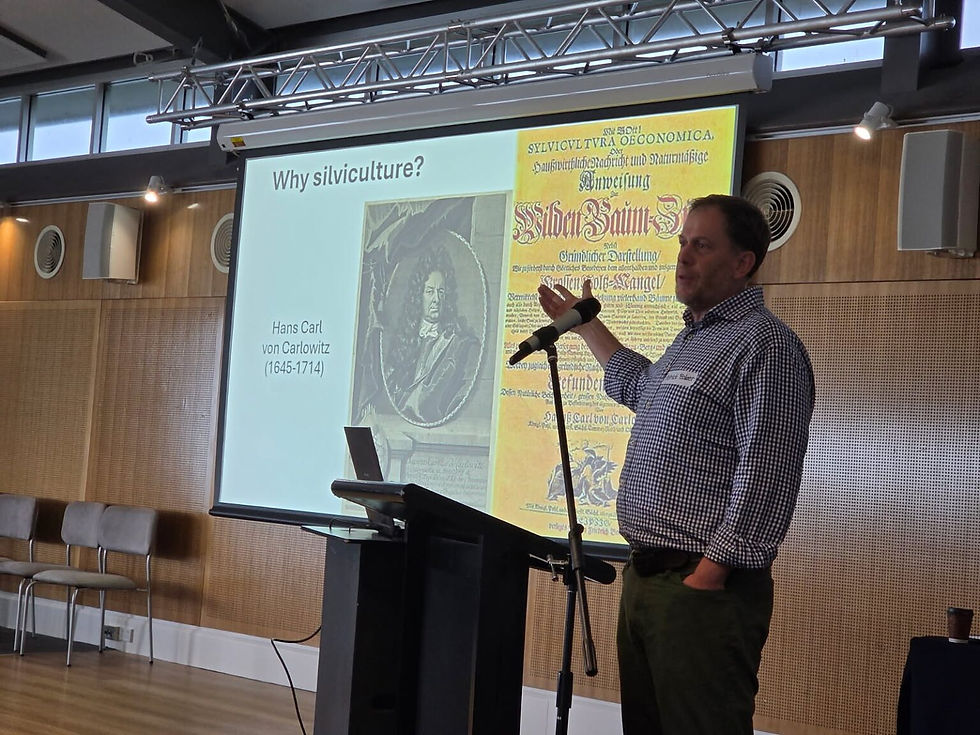
The University of Melbourne’s Patrick Baker traces silviculture to Hans Carl von Carlowitz. (Photo Credit: Supplied to Wood Central / Central PR Group for exclusive use by the North East NSW Forestry Hub)
“There is so much social licence for cultural burning, but no legal right beneath it – the law puts obstacles in the way that make it harder,” Hurford said of University of Adelaide legal scholar Phillipa McCormack’s presentation on the legal barriers to cultural burning. McCormack traced a long lineage of human management and interaction in these forests, he said, within a legal system yet to catch up.
Rounding out Tuesday’s program, a panel chaired by Mitchell brought Hurford, Timber NSW chief executive Maree McCaskill, Weathertex’s Paul Michael, SA Relf & Sons’ Anthony Dorney, FSC Australia and New Zealand chair James Felton-Taylor and Rudman to the same table to name the priority issues for timber in the state’s north east. Mike Sutton, the Forest Innovation Services consultant, presented separately on the case for investing in new hardwood plantations across the region.
Managers boarded a bus the next morning for a tour of the Hunter’s working supply chain, from Marshall’s Timbers in Cardiff to a harvesting operation in Watagan State Forest and Weathertex’s Heatherbrae factory. For Venn, whose updated research is part-funded by the host hub, the numbers leave little room for doubt: Australians now use two cubic metres of elevated-risk timber for every one drawn from the country’s own native forests.


Bình luận