
Premier Eby Takes B.C. Timber Into China to Offset Falling U.S. Sales
- 30 thg 6
- 3 phút đọc
Đã cập nhật: 30 thg 7
Forestry products and LNG expansion top the agenda as Premier David Eby opens British Columbia's first trade mission to China, with combined U.S. softwood duties near 35 per cent pushing the province to chase buyers beyond the United States.
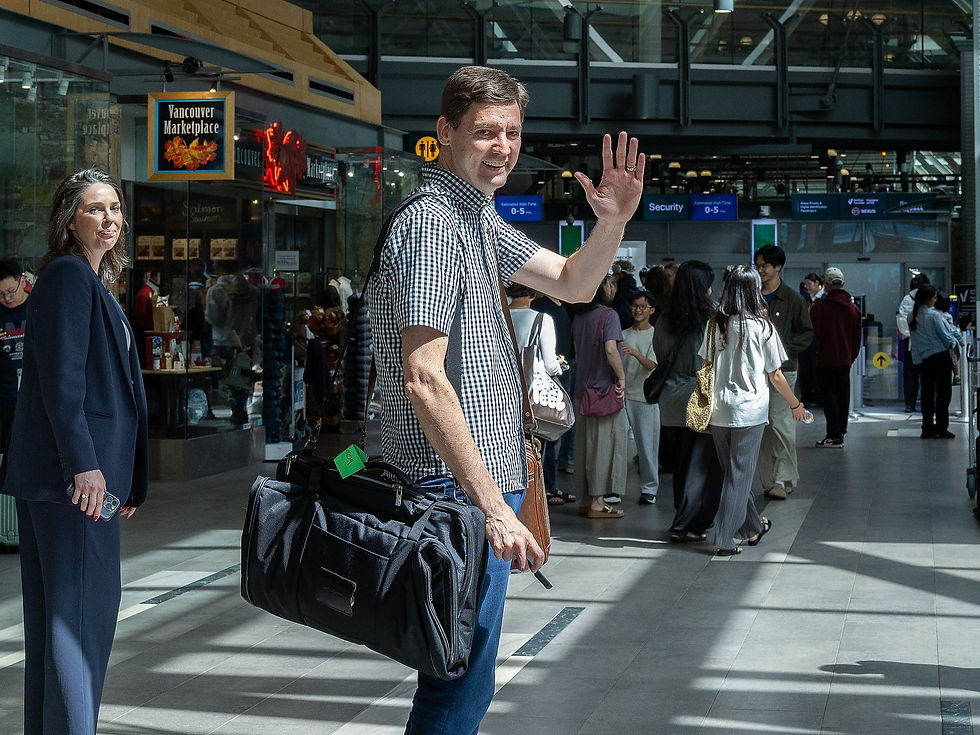
British Columbia Premier David Eby waves before departing Vancouver International Airport for a trade mission to China, where forestry products sit alongside energy and agriculture on a trip aimed at easing the province's reliance on the United States. (Photo Credit: Province of British Columbia)
British Columbia Premier David Eby will use his first trade mission to China to court new buyers for B.C. timber exports, with combined United States duties squeezing Canadian softwood out of the market that has long absorbed most of its shipments. That is according to Eby, who told reporters at Vancouver International Airport on Saturday before departing for Beijing, Shanghai and Guangzhou.
British Columbians had asked the government to broaden the province’s trade relationships, Eby said, with China buying nearly $11 billion of British Columbia goods in 2025, almost a fifth of the province’s commodity exports. “We’ve been too dependent on the United States,” he said, setting a target of doubling the province’s exports to markets beyond the United States within a decade.
The mission would showcase the province’s strengths across forestry, energy, tourism and agriculture, said Ravi Kahlon, British Columbia’s Minister of Jobs and Economic Growth. It would create jobs by “reducing our reliance on U.S. markets through diversified trade partnerships,” Kahlon said.
United States tariffs are hurting the province’s forestry sector, Eby said, with a significant share of British Columbia jobs tied to the China relationship and to exports the province wants to grow. He told reporters he hoped Beijing would remove the tariffs currently weighing on provincial exporters, including in the seafood sector, as part of a wider reset in relations.
Prime Minister Mark Carney had reopened the door to Beijing, Eby said, and British Columbia needed a seat at the table to pursue opportunities across tourism, agriculture and forestry. The premier said he had taken briefings from the Royal Canadian Mounted Police and the Canadian Security Intelligence Service to manage the risks of the visit while pursuing its commercial aims.

Caption: Canadian Prime Minister Mark Carney inspects an honour guard with Chinese Premier Li Qiang at the Great Hall of the People in Beijing in January, the visit Premier David Eby credits with reopening the door to closer trade with China. (Photo Credit: The Canadian Press/Alamy Live News)
The government had withheld Eby’s full itinerary to deny competitors in other provinces and countries any advantage, the premier said, with the mission seeking customers and deals for British Columbia companies. The province produces more than 40 per cent of Canada’s lumber exports, a sector hit hard as combined United States duties pushed the effective rate on most Canadian softwood toward 35 per cent.
The most valuable prize Eby identified for the trip was a meeting with PetroChina over the second phase of the LNG Canada expansion at Kitimat, a project approaching a final investment decision expected later this year. The premier put the expansion’s worth at about $28 billion in provincial revenue, money he said would help pay for public services across British Columbia.
PetroChina sits alongside Shell, PETRONAS, Mitsubishi Corporation and Korea Gas Corporation in the joint venture, whose Phase 2 would add two liquefaction trains, doubling the terminal’s annual output from its current 14 million tonnes. Federal and provincial governments reached an agreement in May to progress the outstanding items before any decision, with Ottawa listing the expansion as a project of national interest.
The mission, originally set to run from 27 June to 3 July, was being cut short at the federal government’s request so the province could settle a memorandum of understanding with Ottawa on major projects. That agreement would ensure British Columbia received fair treatment on developments in the national interest, Eby said, on the same terms as projects in Quebec, Ontario and Alberta.
British Columbia signed a five-year agreement with China in January to deepen cooperation on tall-wood and mass-timber construction, one of several moves that have also taken provincial delegations to Japan and South Korea. Eby’s government puts the province’s forestry workforce at about 95,000, with roughly a quarter of those jobs in the Lower Mainland.


Bình luận