
Brisbane Hands Olympic Pool Materials Call to Winning Builder
Updated: Jul 30
Four shortlisted builders have been given until the end of July to lodge offers for the 25,000-seat Spring Hill venue, with a design-and-construct delivery model set to place the material decision with whichever contractor wins.

Branching supports carry the wave roof over a public concourse at the National Aquatic Centre, in renders released six years to the day before the Brisbane 2032 opening ceremony. (Image Credit: ARM Architecture, NH Architecture, and Arkhefield / Queensland Government)
Queensland has unveiled the first renders of Brisbane 2032’s National Aquatic Centre, and the builder who wins the job will decide what the venue’s sweeping wave roof is made from. That is according to industry sources with knowledge of the procurement process, who told Wood Central that one of the Olympics’ marquee venues will be delivered under a design-and-construct contract.
It comes after Deputy Premier Jarrod Bleijie named ARM Architecture, NH Architecture, and Queensland’s Arkhefield as the design team yesterday, six years to the day before the opening ceremony, with four shortlisted contractors’ offers closing at the end of July and the field to be cut to two within weeks. Nothing in the announcement specifies a structural material (although the renders show a supporting timber frame supporting the pool’s sweeping roof), and the design trio has yet to engage the supply chain.
“This design trio will develop an iconic new home for high-performance aquatic athletes,” Bleijie said, with GIICA confirming the venue runs the same dual early contractor involvement model as Brisbane Stadium and a final builder due by early 2027. Running the designer and builder procurements concurrently will keep the venue to its timeline, Premier David Crisafulli said.
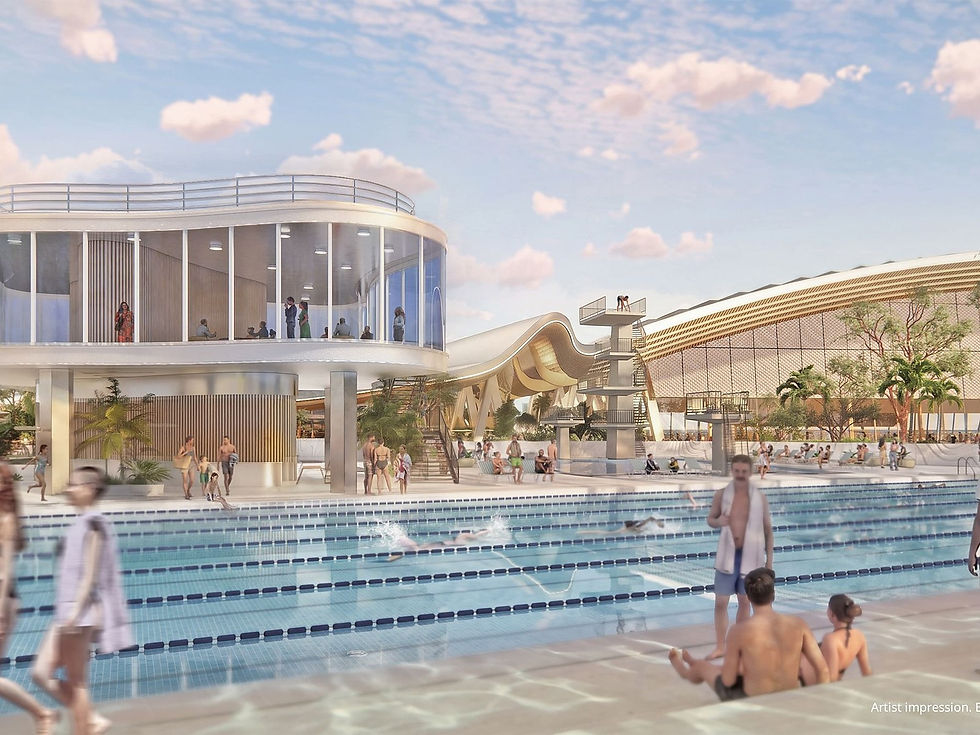
Divers and the restored outdoor pools of the heritage-listed Centenary Pool sit in front of the new halls, with the wave roof dipping between the dive towers in the released scheme. (Image Credit: ARM Architecture, NH Architecture, and Arkhefield / Queensland Government)
“The rippling plinth and floating roof reflect the movement of water,” ARM Architecture Director Andrew Hayne said of a design he claims is shaped by Brisbane’s landscape, subtropical climate, and natural environment. Stephen Conry AM, the GIICA Chairman who chaired the Design Evaluation Panel, said the winning scheme was “inspired by the movement of water, cleverly positioned into the landscape”.
New pools, a gym, and high-performance training and office space fill the halls beneath the wave, with the design wrapping the restored outdoor pools of the James Birrell-designed Centenary Pool, the heritage-listed complex that gave Brisbane its first Olympic-standard pool in 1959. Andrew Gutteridge, Arkhefield’s Founding Director, grew up swimming there and said the project will serve Queenslanders long after the Games end.
Builders elsewhere have already made that call, with Paris putting the only permanent venue of the 2024 Games beneath an 89-metre Mathis glulam roof and Adelaide opening Australia’s newest aquatic centre in January under the largest glulam beams ever installed in the country. Chlorine-laden pool air attacks exposed steel, one reason engineered timber has spread through new pool halls, Sydney’s Gunyama Park among them.
Brisbane 2032 already has one mass timber venue in the Moreton Bay Indoor Sports Centre, with University of Queensland researchers arguing last month that the barriers to timber Olympic venues are now commercial rather than technical. Next door at Victoria Park, the builder contest is further advanced, with Built and SACYR facing John Holland and BESIX Watpac for the $3.8 billion Brisbane Stadium and a decision due later this year, months before GIICA names the aquatic centre’s own.
Bleijie declined to say whether the 25,000 Games seats could be trimmed to hold costs, insisting the $7.1 billion venues envelope will not move. GIICA takes possession of the Spring Hill site on 1 September, and on the authority’s own numbers, the finished centre will hold more spectators for Olympic swimming than Paris La Défense Arena did in 2024.


Comments